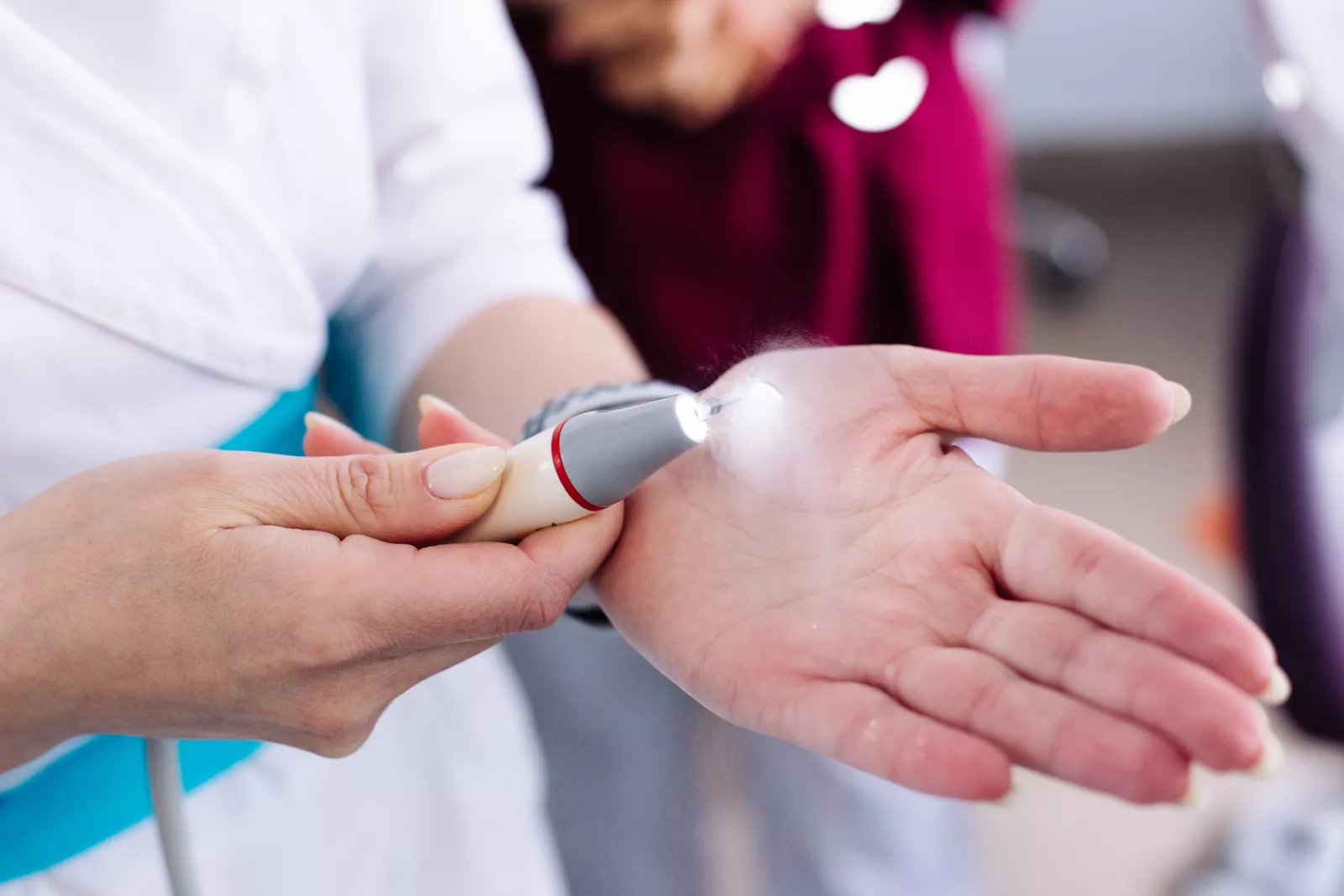
Every vapocoolant application begins with a small physics problem most clinicians never stop to consider. Mucosal resistance shapes how much cooling actually reaches the tissue, and spray velocity determines whether the effect lands where it needs to. Balancing the two variables is the quiet science behind why a well-designed vapocoolant works and a poorly-designed one does not.
Mucosal tissue is not a simple flat surface, and neither is the spray hitting it during application. Fluid dynamics, tissue density, and surface geometry all interact within the one to two seconds a clinician holds the trigger. Understanding the interplay gives dental teams a clearer read on why technique and device engineering both matter at the chair.
What Is the Relationship Between Mucosal Resistance and Precision Spray Velocity?
Mucosal resistance and precision spray velocity together determine how much cooling reaches the target tissue during a vapocoolant application. Higher resistance from denser or drier mucosa reduces heat transfer, while a controlled spray velocity delivers the coolant evenly without wasting product or overshooting the site. The two variables must be matched for the device to produce predictable clinical results.
What Mucosal Resistance Actually Means at the Injection Site
Mucosal resistance describes how much the oral tissue slows heat transfer, drug diffusion, and mechanical force during a clinical application. The resistance is not uniform across the mouth, and it changes with tissue type, hydration, and even the patient's age.

Understanding those variables gives dental teams a clearer read on why the same product performs differently in different sites.
Tissue Type Matters - Keratinized mucosa on the hard palate resists heat transfer and diffusion more than non-keratinized buccal or floor tissue.
Hydration Affects Coverage - Dry mucosa scatters spray droplets and reduces contact, while a thin saliva coating helps the coolant land evenly.
Thickness Varies by Site - Buccal mucosa runs 500 to 800 microns thick, while sublingual mucosa is closer to 130 to 190 microns.
Vascular Supply Shifts Response - Highly vascularized regions clear heat faster, which can shorten the effective cooling window at that site.
Barrier Layers Slow Diffusion - Epithelial cell junctions and lipid matrices in the mucosa resist penetration by both drugs and thermal energy.
According to a review of oral mucosal permeability and pathophysiology, normal aging has minimal effect on permeability, but pathological changes like inflammation or thinning can shift resistance substantially. The finding matters clinically because tissue condition on the day of the appointment shapes how any vapocoolant performs. Consistent technique across variable tissue is what separates smooth applications from unpredictable ones.
The Physics of Precision Spray Velocity in Vapocoolant Delivery
Spray velocity governs how coolant droplets travel from the nozzle to the mucosa and how efficiently they evaporate on contact. Too slow, and droplets fall out of the stream before reaching the tissue at all. Too fast, and they bounce off the surface before evaporating fully into the target area.
According to a study on vapocoolant spray effects during intravenous cannulation, alkane vapocoolants rely on rapid evaporation to lower surface temperature and interrupt pain sensation. The evaporation rate depends heavily on droplet size, spray distance, and how the liquid transitions to gas on contact. Each variable shifts the amount of cooling that actually reaches the tissue during the brief application window.
Droplet size is largely a function of nozzle design and internal canister pressure at the moment of trigger. Smaller droplets evaporate faster and cool more efficiently, though they also scatter more easily in a moving stream. Larger droplets carry farther but transfer heat less completely once they land on the tissue.
According to the FDA's classification framework for vapocoolant devices, non-clinical performance testing must characterize the change in skin surface temperature during intended use. Regulatory expectations reflect what the underlying physics demands from any well-designed device. Precision, in that context, means engineering both velocity and droplet profile to match the exact clinical moment.
How Mucosal Resistance and Spray Velocity Interact During Application
The interaction between mucosal resistance and spray velocity determines whether a vapocoolant application actually delivers the cooling it promises. High resistance combined with low velocity produces uneven cooling and wasted product across the target site. Low resistance paired with excessive velocity risks overshooting the tissue and losing coolant to the surrounding oral cavity.
The balance shifts across different intraoral sites, which is why one setting rarely fits every injection type. Clinical judgment fills the gap between engineered spray parameters and real patient anatomy in the chair.
According to a review of oral mucosal barrier models, the keratinized layer of the mucosa presents a major barrier to penetration and heat transfer at multiple oral sites. The morphology of the underlying epithelium varies by region, and each region has its own absorption profile. Spray parameters that work on buccal mucosa may underperform on the hard palate without adjustment.
Furthermore, clinical technique compensates for a large portion of the interaction between resistance and velocity. Distance from the nozzle to the tissue changes both the droplet velocity at impact and the evaporation window before contact. Assistants who learn to modulate distance and angle for each site get more consistent cooling across the schedule.
How DentalJect Balances Mucosal Resistance and Spray Velocity by Design
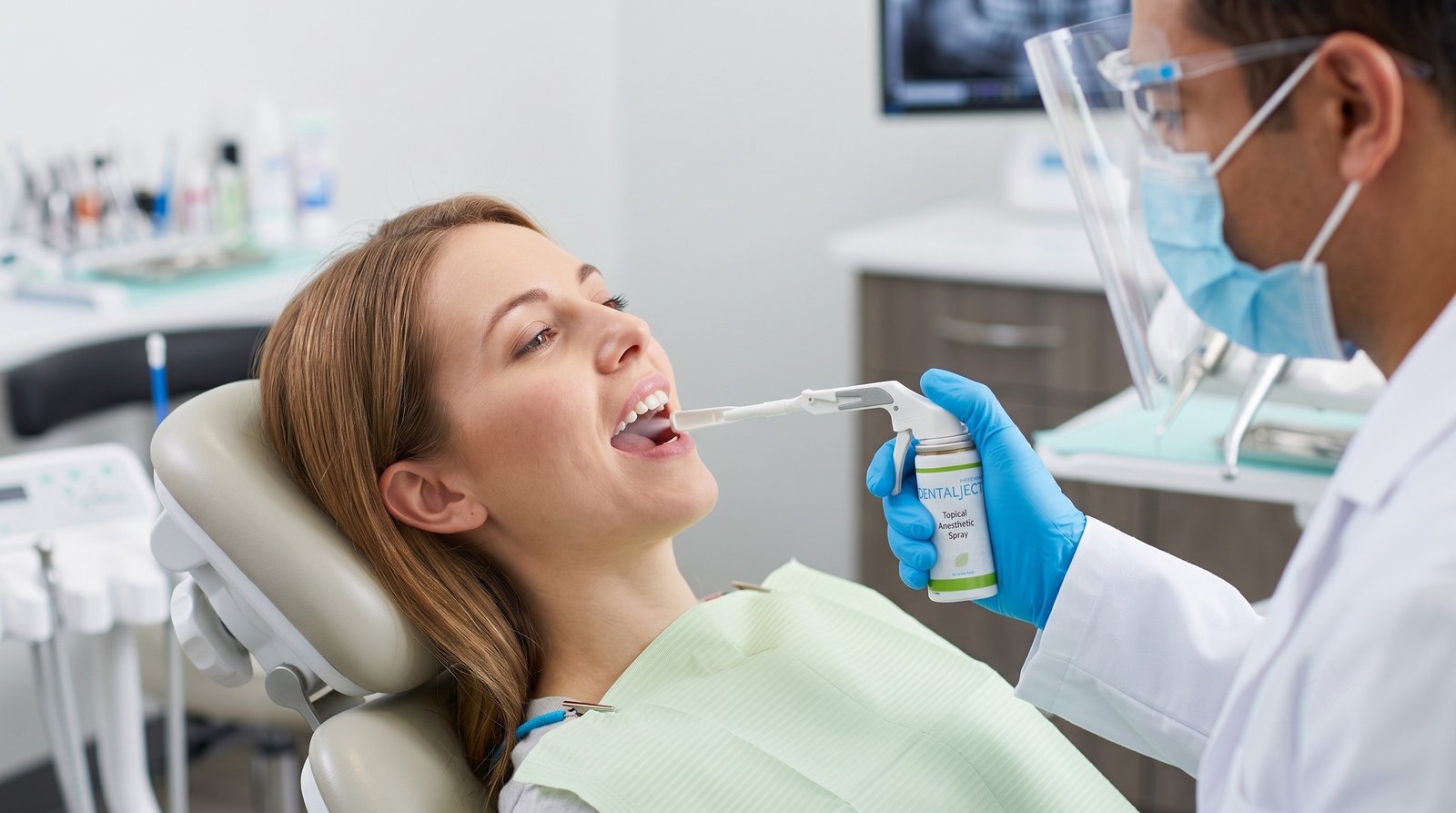
DentalJect addresses the mucosal resistance and spray velocity equation through engineered dispensing parameters rather than clinician-adjusted variables. The canister dispenses coolant at approximately one gram per second, which produces a predictable droplet stream regardless of who holds the trigger. Standardized delivery removes one variable from an already complex application moment.
The device positions the Guide Ring on or up to one inch from the injection site to control spray distance directly. Distance control matters because droplet velocity and evaporation rate both shift with the gap between nozzle and mucosa. Building the correct distance into the tool itself shortens the learning curve for any assistant running the protocol.
The nozzle is designed for perpendicular application to the mucosa, which optimizes coverage across variable tissue types. Perpendicular delivery reduces splash, flowback, and uneven cooling across dense regions like the hard palate. The rotating shield further protects surrounding sensitive tissue from stray droplets during the two-second application window.
Meanwhile, the coolant formulation itself is matched to intraoral mucosal conditions rather than external skin. HFO-1234ze evaporates cleanly on oral tissue and produces reliable surface cooling within the physiologic window the injection actually requires.
Ready to Bring Precision Cooling Into Your Injection Protocol?
Mucosal resistance and spray velocity are quiet variables that shape every vapocoolant application in your operatory. Matching device engineering to the physics of intraoral tissue delivers cooling where and when the injection actually needs it. Small differences in droplet size, distance, and delivery angle add up to noticeable clinical results.
DentalJect handles the engineering side so your team can focus on technique, timing, and patient comfort at chairside. The device pairs cleanly with your existing anesthetic protocol and drops in without workflow disruption. Book a conversation with the VCS Medical team about adding DentalJect to your dental injection protocol.
Ready to start the No-Wait Injection Protocol?
Add DentalJect to your practice with the Intro Bundle.
Get the Intro Bundle